


What Is Stretch Hood Film? Industrial Pallet Packaging Guide
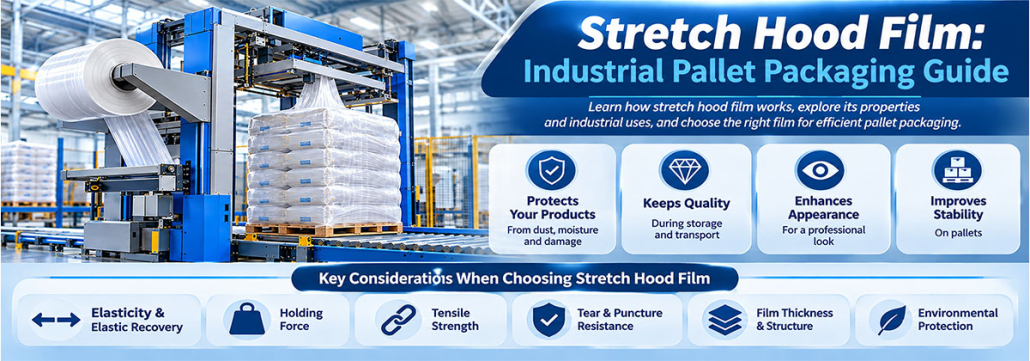
In industries such as cement, chemicals, polymers, and paper, pallet packaging does much more than make products easier to transport. It helps keep loads together, protects goods during handling, and reduces the risk of packaging damage before products reach their destination.
Consider a pallet of cement bags leaving a production facility. Before reaching the customer, it may be moved several times, stored in a warehouse, loaded onto a truck, and exposed to different environmental conditions. Throughout this journey, the packaging must withstand mechanical stress while keeping the load properly contained.
The same challenges apply to many other industrial products, including plastic resins, chemical materials, paper goods, and boxed products. Differences in weight, dimensions, surface shape, and stacking patterns can all affect packaging performance.
This is why choosing the right pallet packaging film involves more than comparing thicknesses or prices. The film must stretch properly during application, provide suitable load containment afterward, and perform reliably under the conditions in which the pallet will be stored and transported.
One option worth considering is stretch hood packaging. It uses an elastic tubular film that a dedicated machine stretches over a palletized load. The film covers the top and sides and extends toward the pallet base, helping hold the products together without requiring a heat-shrinking stage.
Understanding how stretch hood film works—and which properties matter most—can help manufacturers determine whether it is the right solution for their packaging line.
What Is Stretch Hood Film?
Stretch hood film is a stretchable plastic film, usually manufactured in a tubular form, that is used to cover and secure palletized products. During application, a stretch hood machine expands the film and pulls it over the load. Once positioned, the film’s elastic behavior helps it fit around the products and maintain the required level of containment.
Many stretch hood films are made primarily from linear low-density polyethylene (LLDPE). Depending on the intended application, the film may use a multilayer structure designed to balance stretchability, mechanical strength, tear resistance, and puncture resistance.
The exact material formulation and layer arrangement vary by product specification. A film designed for heavy bags with uneven surfaces, for example, may require a different balance of properties from one intended for neatly stacked boxes.
It is also important to distinguish between the film itself and the complete packaging system. Even a well-designed film may not perform as expected if the machine is unsuitable, the pallet is poorly arranged, or the film dimensions do not match the load.
In practice, the best results come from evaluating the film, equipment, and pallet configuration together.
How Does Stretch Hood Packaging Work?
Unlike shrink hood packaging, which relies on heat to shrink the film around a load, stretch hood packaging uses mechanical stretching to position the film.
Although the details vary between machines, the process generally involves three stages.
- Preparing the film
The film is selected according to the dimensions, weight, and shape of the palletized load. Its dimensions and stretching characteristics must be compatible with the packaging machine and the load it needs to cover.
- Stretching the film over the load
The machine stretches the tubular film and pulls it down over the pallet. The film expands as it passes over the load, then fits around the sides and extends toward the base.
The amount of stretch and the application sequence depend on the film specification, machine design, and load geometry.
- Securing and covering the pallet
Once applied, the film’s elastic behavior helps keep the products together. By covering the top and sides, the hood can also reduce exposure to dust and environmental moisture, provided the film and package configuration are suitable for the intended conditions.
Because the process does not require heat shrinking, it avoids the heat exposure associated with that stage. This may be useful when the packaged product or its existing packaging is sensitive to heat.
However, the absence of a heating stage does not automatically make a package suitable for every application. Film selection, machine settings, load arrangement, and real-world handling conditions still need to be considered.
Stretch Hood vs. Stretch Wrap: What’s the Difference?
Stretch hood and conventional stretch wrap are both used to secure palletized products, but they apply film in different ways.
With conventional stretch wrapping, a machine winds stretch film around the pallet, usually in overlapping layers. The sides are covered, while the top may require a separate cover, depending on the packaging requirements.
Stretch hood packaging takes a different approach. A tubular film is stretched over the load, covering the top and sides and extending toward the pallet base. This can combine load containment with broader coverage in a single application.
| Comparison factor | Stretch hood | Conventional stretch wrap |
| Application method | A stretched tubular film is pulled over the load | Film is wound around the load in overlapping layers |
| Load coverage | Can cover the top and sides with one hood | Primarily covers the sides; additional top coverage may be needed |
| Load containment | Elastic behavior and recovery help hold the load | Applied tension and overlapping layers help secure the load |
| Environmental protection | Provides broad coverage, depending on film and application | Depends on the wrapping pattern and any additional covers |
| Heat requirement | No heat-shrinking stage is required | No heat-shrinking stage is required |
| Equipment | Requires compatible stretch hood equipment | Requires a compatible stretch wrapping machine |
| Key selection factors | Stretch behavior, holding force, mechanical resistance, and coverage | Stretchability, applied tension, mechanical strength, and wrapping pattern |
Neither method is automatically the better choice. Stretch wrap may suit operations with existing wrapping equipment or highly variable load configurations. Stretch hood may be worth evaluating when full-load coverage, automated application, and consistent results are priorities.
The right choice depends on the products being packaged, the available equipment, the required level of protection, and the conditions the pallet will encounter during storage and transportation.
Which Stretch Hood Film Properties Matter Most?
A film’s performance depends on how several material properties work together. Looking at any one property in isolation can lead to an incomplete assessment.
Elasticity and Elastic Recovery
Elasticity describes a film’s ability to stretch under an applied force. Elastic recovery describes its tendency to return toward its original dimensions after stretching.
Both properties matter in stretch hood packaging, but they serve different purposes. A film may stretch considerably during application without necessarily providing the holding force required once it is installed.
The aim is to achieve enough stretch for the film to pass over the load while maintaining suitable containment afterward. The relationship between elasticity, recovery, load dimensions, and machine settings influences how effectively the hood fits around the pallet.
For this reason, film selection should consider both how the material behaves during application and how it performs once the package is complete.
Holding Force
Holding force refers to the force the applied film exerts to help keep the load together.
For pallet packaging, this is particularly important because the film must do more than fit around the products. It must also contribute to maintaining the load’s arrangement during handling and transportation.
The required holding force depends on factors such as load weight, package dimensions, stacking pattern, and handling conditions. A suitable specification should therefore be based on the actual application rather than a general assumption that one film will work equally well for every pallet.
Tensile Strength
Tensile strength describes a film’s resistance to tensile loading.
During stretch hood application, the film is subjected to stretching forces. Its tensile properties must be appropriate for the application process and the demands placed on the finished package.
However, tensile strength alone does not determine whether a film is suitable. The material must also provide the required stretchability, recovery, and resistance to damage.
Tear Resistance and Puncture Resistance
These two properties are related to mechanical durability, but they describe different types of damage.
Tear resistance is the film’s ability to resist the initiation or propagation of a tear. Puncture resistance describes its ability to withstand localized penetration by a sharp object or protrusion.
Both can be important when packaging bags with sharp corners, unevenly stacked products, or loads that experience repeated contact during handling.
A film may have suitable stretching characteristics but still be vulnerable to tearing or puncturing if its mechanical properties do not match the load. Conversely, high mechanical strength does not automatically mean that a film will stretch or recover as required.
The goal is to find the right balance for the products and operating conditions involved.
Film Thickness and Multilayer Structure
Film thickness is an important specification, but a thicker film is not necessarily the best choice.
Many stretch hood films use a multilayer structure. Depending on the formulation, different layers can contribute to properties such as elasticity, mechanical strength, and surface performance.
This construction can help balance properties that may be difficult to achieve with a single material layer. However, neither the number of layers nor the nominal thickness alone establishes a film’s quality.
A thinner film may be suitable for an application if its material structure and mechanical performance meet the required specifications. The decision should be based on the load, application conditions, relevant test results, and packaging trials—not thickness alone.
Environmental Protection
Stretch hood packaging covers the top and sides of a pallet, which can help reduce exposure to dust and environmental moisture.
The level of protection depends on the film’s properties, the continuity of the coverage, how the hood fits the load, and the surrounding conditions. Some specialized films may also be designed for particular exposure requirements, such as ultraviolet radiation.
Full coverage should not automatically be interpreted as waterproofing or complete isolation from the environment. If moisture protection is critical, the required performance needs to be clearly defined and verified for the intended application.
Compatibility with Packaging Equipment
Even a film with suitable material properties may perform poorly if it is incompatible with the packaging machine.
Film dimensions, stretching behavior, load geometry, and machine design all influence the application process. If these factors are not properly matched, the result may be inconsistent coverage, excessive stress during application, or a package that does not provide the intended containment.
Manufacturers should therefore assess film compatibility using the equipment and production conditions under which it will actually be used.
How Does Stretch Hood Film Affect Pallet Stability?
Pallet stability depends on how effectively the packaging system keeps the products together and maintains the overall arrangement of the load.
When correctly selected and applied, stretch hood film can help limit movement between packaged units through its elastic behavior and holding force. This can support load containment during storage, handling, and transportation.
However, load containment and pallet stability are not the same thing. A tightly fitted hood cannot compensate for every problem caused by poor stacking, an unsuitable pallet, or uneven weight distribution.
Several factors need to be considered together:
- Load arrangement: The position and alignment of individual packages affect how the pallet responds to handling.
- Product characteristics: Weight, surface shape, and sharp edges influence the stresses experienced by the film.
- Pallet condition: Pallet dimensions and structural integrity affect the performance of the complete package.
- Film properties: Elastic recovery, holding force, and mechanical resistance contribute to load containment.
- Application conditions: Machine settings and consistency of application affect the finished hood.
These factors become especially important for heavy or irregularly shaped loads. Evaluating the film on representative pallets is a more reliable way to assess its suitability than relying on a product description alone.
Why Do Machine Settings Matter?
Choosing the right film is only part of the process. The packaging machine must also apply it consistently.
Machine settings determine how the film is stretched, positioned, and fitted around the load. Unsuitable settings can result in inconsistent coverage, excessive stress on the film, or inadequate containment.
The appropriate operating conditions depend on the film specification, machine design, and dimensions and shape of the palletized load. Settings should follow the equipment manufacturer’s guidance and be validated for the particular application.
It is also worth checking consistency across successive pallets. Changes in load dimensions, film behavior, or operating conditions may affect package quality even when the nominal film specification remains the same.
A practical evaluation should examine the finished hood, film integrity, coverage, and the condition of representative pallet loads after handling. This helps determine whether the film and machine are working effectively as a complete packaging system.
Choosing Stretch Hood Film for Different Industries
Different products place different demands on pallet packaging. The appropriate film specification depends on the load’s characteristics and the conditions it will encounter.
Cement and Bagged Construction Materials
Cement bags and other bagged construction materials are often stacked into heavy pallet loads. The packaging system must provide suitable containment while withstanding the mechanical stresses associated with handling and transportation.
Important considerations include total load weight, bag arrangement, pallet dimensions, and the possibility of sharp or uneven surfaces damaging the film. Depending on storage and transportation conditions, reducing exposure to dust and environmental moisture may also be a priority.
For these applications, film selection should balance holding force, mechanical resistance, and consistent coverage.
Chemical and Polymer Products
Chemical and polymer products may be supplied in bags, sacks, containers, or other packaging formats. These differences influence the required film dimensions, mechanical properties, and level of environmental protection.
Heat sensitivity may also be relevant, particularly when the existing packaging could be affected by elevated temperatures. Because stretch hood application does not require a heat-shrinking stage, it may be worth evaluating for applications where avoiding that stage is beneficial.
The final choice should still be based on product requirements, equipment compatibility, and the performance expected from the finished pallet.
Paper and Paper-Based Products
Paper goods and boxed products may need protection from dust and environmental moisture during storage and transportation.
Their dimensions, surface characteristics, and stacking arrangements affect how the hood fits around the load. A suitable film should provide the required coverage while maintaining adequate mechanical performance throughout handling.
Other Industrial Products
For mixed or irregular loads, selection should begin with the specific packaging challenge.
Variations in load dimensions, surface shape, stacking patterns, and handling conditions may affect whether stretch hood is suitable. Where load sizes vary considerably, the film must be assessed against the operating capabilities of the machine and the full range of products being packaged.
There is no single film specification that suits every industry. The right choice is the one that consistently meets the requirements of the application.
What Should You Check Before Selecting Stretch Hood Film?
Before choosing a film specification or requesting a quotation, it helps to gather a clear picture of the packaging operation.
Consider the following questions:
- What are you packaging? Are the products supplied in bags, boxes, containers, or another format?
- What are the pallet dimensions? Record the pallet length and width, along with the total load height.
- How heavy is the load? Consider the total weight and how that weight is distributed.
- What is the load geometry? Are the surfaces regular, or are there sharp corners and uneven sections?
- What conditions will the pallet encounter? Consider storage, handling, transportation, and environmental exposure.
- What protection is required? Is the main priority load containment, dust protection, moisture protection, or a combination?
- Which mechanical properties matter most? Define the required levels of elasticity, holding force, tensile strength, tear resistance, and puncture resistance.
- Which packaging machine will be used? Confirm the equipment’s supported film dimensions and operating requirements.
- How consistent must the process be? Will the film be used for one load configuration or several different pallet sizes?
- What are the production and supply requirements? Consider expected film consumption, production volume, and consistency of supply.
Where possible, candidate films should be tested on representative loads using the intended packaging equipment. Evaluating the finished packages under realistic handling conditions provides a stronger basis for selection than comparing thickness or individual property values alone.
Conclusion
Stretch hood film offers manufacturers a way to cover and secure palletized products without a heat-shrinking stage. Its elastic behavior can help contain the load, while its coverage of the top and sides can reduce exposure to dust and environmental moisture when the film and application are suitable.
But reliable packaging depends on more than one material property. Elasticity, recovery, holding force, tensile strength, tear resistance, puncture resistance, film thickness, and equipment compatibility all contribute to the final result.
For industrial manufacturers, the objective is not simply to select a thicker or stronger film. It is to find a specification that meets the actual requirements of the product, pallet configuration, packaging line, and distribution environment.
At Karya Polymer, understanding these requirements is a useful starting point for evaluating industrial pallet packaging solutions. Information about the product, pallet dimensions, load weight, operating conditions, and packaging equipment helps establish a clearer basis for selecting an appropriate stretch hood film.
Ultimately, the right choice begins with the application: understand the load, define the performance requirements, and evaluate the film as part of the complete packaging system.


Leave a Reply
Want to join the discussion?Feel free to contribute!