


What Is Vacuum Skin Packaging Film? Benefits and Process
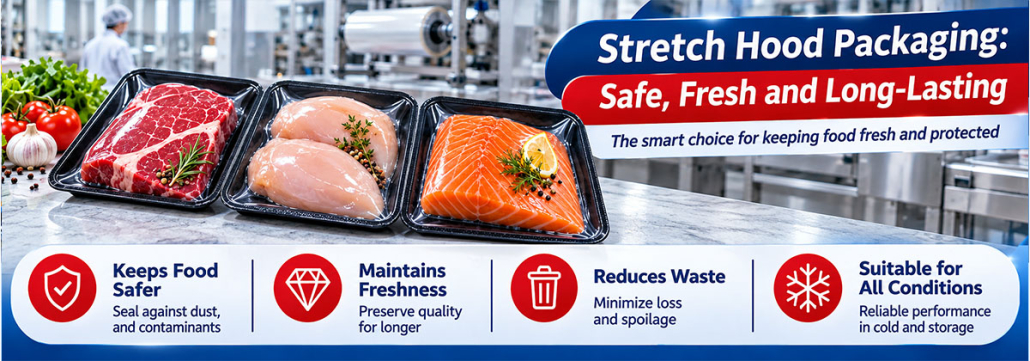
For meat, seafood, cheese, and prepared-food producers, packaging has to do more than contain a product. It must protect quality through handling and storage, present the food clearly to buyers, and fit the realities of a production line. Vacuum skin packaging (VSP) addresses these needs by bringing a flexible film closely against the product and sealing it to a tray or other support. The result is a compact pack that keeps the food visible while limiting the air space around it.
Performance depends on film structure, puncture resistance, sealing conditions, the supporting tray, and the food itself. Understanding these factors helps packaging teams assess whether a vacuum skin packaging film suits their product and process.
What Is Vacuum Skin Packaging?
Vacuum skin packaging is a method in which a heated, flexible top film conforms closely to a food product, following its contours like a second skin. The film is sealed to the supporting tray or substrate around the product, leaving little unnecessary space inside the finished pack. Unlike a loose pouch, the film holds the product in position and allows its shape and surface to remain clearly visible.
A skin pack commonly uses a transparent, multilayer film designed to balance formability, clarity, sealing performance, and protection. High-barrier versions are intended to limit the passage of gases such as oxygen. Some product systems are designed to preserve freshness without modified atmosphere packaging (MAP), although this should be confirmed for the particular film, product, and process rather than assumed of every VSP system.
The format is used for fresh and processed meat, bone-in cuts, fish and seafood, cheese, deli products, ready meals, and frozen foods. The required barrier, mechanical strength, temperature resistance, and sealing characteristics depend on the application.
How Does the Process Work?
The exact equipment and settings vary by packaging line, but the basic process follows a sequence:
- Position the product. The food is placed on a compatible tray or support. The product and tray need to be arranged so the film can reach the intended contours and sealing area.
- Heat the top film. A specialist film is warmed so that it becomes flexible enough to conform around the product. Heating must suit the film and the machine process.
- Apply vacuum and form the film. Air is removed from the relevant space, allowing the film to descend around the food and fit closely to its shape. The aim is to avoid loose areas, wrinkles, and trapped air pockets that can compromise appearance or package performance.
- Seal the pack. In the system described in the supplied product material, residual heat from the top film helps it adhere around the product, while pressure and heat sealing close the film to the tray edges. The food-contact conformity and the tray-edge seal perform related but distinct functions.
- Check the finished pack. The package should be assessed for conformity, seal integrity, visible defects, and suitability for its intended storage and distribution conditions.
Some films are described as self-adhesive or glue-free: adhesion is achieved during packaging rather than with a separate adhesive. The finished pack still depends on compatibility between the film, tray surface, and sealing conditions.
Vacuum Skin Packaging vs. Conventional Vacuum Packaging
Both vacuum skin packaging and conventional vacuum packaging reduce the amount of air around a food product, but the finished packs behave differently.
In a conventional vacuum pouch, the product is enclosed in a flexible bag that fits around it to varying degrees. The film may move or wrinkle as the product is handled, and the package is not necessarily supported by a rigid tray. In VSP, the top film is drawn tightly over the food and sealed to a tray or backing. The product is held in place, and its outline remains visible through the film.
This difference can help retail presentation: a skin pack creates a neat display, reduces loose film, and in suitable formats allows vertical shelf placement. Close contact may also reduce movement and visible liquid pooling, depending on the product and process.
Neither format is universally better. A pouch may suit products or production systems where a tray is unnecessary, while VSP may be worth evaluating when stable positioning, product visibility, and a compact presentation are priorities. Selection should be based on the product, required protection, machinery, distribution conditions, and total packaging costs—not appearance alone.
Why Film and Tray Selection Matter
The top film is more than a transparent cover. It must conform under the line’s operating conditions, maintain clarity, seal reliably, and withstand packing, transport, and storage stresses. Its properties should match the food and intended use.
Barrier performance is one important consideration. Multilayer coextruded films can be designed to restrict oxygen transmission and help protect food quality. Some film structures use an EVOH barrier layer. However, the presence and performance of a particular barrier layer should be confirmed in the technical specification for the film being considered; it should not be assumed that all skin films have the same construction or barrier level.
Mechanical resistance matters when products have sharp edges or bones. The supplied material identifies high puncture resistance as a feature of some skin films, including versions intended for bone-in meat, seafood, and frozen products. That does not remove the need for application testing: the food’s shape, bone geometry, handling, and distribution conditions can all affect puncture risk.
The tray must suit the food, provide a suitable sealing surface, and work with the film and equipment. Strong barrier properties cannot compensate for a poor seal or incompatible tray, so buyers should assess the complete system.
Adhesion, Sealing, and Barrier Properties
A reliable skin pack depends on two related requirements: the film must conform closely to the product, and the package must be sealed correctly. The close-fitting film gives the product its “second-skin” appearance and holds it in place, while the tray-edge seal closes the package. Both must perform properly for the pack to deliver the expected protection and presentation.
Barrier properties help limit the movement of gases and, depending on the material, moisture through the packaging. Reduced oxygen exposure can slow oxidation, which may otherwise affect fats, flavor, and product quality. It can also slow the growth of many oxygen-dependent spoilage organisms. These effects are protective, not absolute: vacuum packaging does not sterilize food or stop every form of microbial growth.
Shelf life therefore depends on the food, film structure, seal integrity, hygiene, and storage temperature. Any shelf-life claim should be supported for the specific product and process.
Practical Benefits for Food Producers
Clearer product presentation
The transparent film follows the food’s contours, allowing buyers to inspect its shape, cut, and surface through a tidy, consistent pack. The close fit also keeps the product positioned during handling and display.
Product protection and handling
A close-fitting pack can reduce product movement and help protect its shape during distribution. A suitable barrier film can also help limit oxygen exposure and drying. For frozen products, a suitable skin film may help protect against freezer burn, while high-puncture-resistance films may be useful for foods with sharp edges. These benefits depend on choosing a film and package structure appropriate to the application.
Potential to reduce food waste
When packaging helps a product retain acceptable quality for longer, retailers may have more time to sell it and consumers may have more time to use it before spoilage. Better protection against drying or handling damage may also reduce discards linked to quality loss. However, the scale of any waste reduction varies with the food, supply chain, storage practices, and package performance. Packaging is one part of waste prevention, not a guarantee on its own.
Compact packs and transport efficiency
The close fit can create a compact package. A compact pack may reduce material use, improve transport efficiency, and lower transport-related CO₂ emissions. Results depend on the tray, film, pack dimensions, loading, and logistics; environmental assessment should also consider plastic use and end-of-life disposal.
Convenience and retail flexibility
Some skin films include easy-opening features, which can improve the consumer experience when correctly matched to the pack design. The close-fitting format can also support vertical shelf display where the tray, seal, and product are suitable for it. Branding and labelling options should be evaluated alongside the functional requirements rather than treated as substitutes for protection and seal integrity.
Where Is Vacuum Skin Packaging Used?
Food skin packaging is used across several application areas:
- Fresh and processed meat, including bone-in cuts
- Fish and seafood, including shellfish and crustaceans
- Cheese and deli products
- Ready meals
- Frozen foods and products exposed to temperature changes
These are potential application areas, not universal compatibility. A film for refrigerated meat may not suit frozen food or a reheatable meal. Review temperature exposure, puncture risk, barrier needs, tray design, and storage conditions; if microwave use is required, confirm suitability of the complete package.
How to Choose the Right Vacuum Skin Packaging Film
For procurement teams and production managers, selection should begin with the product and the process, not a general claim that a film is “high performance.” Consider the following questions:
- What food is being packed? Identify whether it is meat, poultry, seafood, cheese, a ready meal, or a frozen product. Note sharp bones, shell edges, liquid release, and other physical characteristics that could affect the pack.
- What protection is required? Establish the relevant oxygen and moisture barrier requirements, expected storage conditions, and the quality attributes that must be maintained. Confirm the actual film structure and technical data.
- Which machine and process will be used? Check compatibility with the packaging equipment, heating and forming conditions, vacuum process, and sealing parameters. A film should be evaluated on the intended line.
- Is the tray compatible? Confirm that the film seals reliably to the tray material and that the finished pack holds the product as intended.
- What happens after packing? Consider refrigeration or freezing, temperature variation, transport, stacking, retail display, and consumer opening. A package that looks good immediately after sealing must also remain suitable throughout its intended journey.
- What is the commercial and environmental balance? Compare film and tray use, pack dimensions, transport efficiency, line performance, ease of opening, and disposal or recycling considerations. Claims about material savings or recyclability should be checked against the actual structure and local waste-management arrangements.
Where possible, run trials with the actual product, tray, machine settings, and distribution conditions. Assess appearance, seal integrity, puncture resistance, opening performance, and product quality over the intended storage period.
Food Safety and Practical Limitations
Vacuum skin packaging is a preservation aid, not a sterilization method. Reduced oxygen can slow some spoilage processes, but it does not prevent all microbial growth. Vacuum-packed foods still require hygienic production, appropriate refrigeration or freezing, validated shelf-life controls, and clear storage and use-by instructions. Low-oxygen conditions can allow certain hazards, including Clostridium botulinum, to develop if the product is mishandled or stored incorrectly, so packaging should be part of a validated food-safety system.
There are also practical trade-offs. VSP may require specialist equipment and suitable packaging materials, which can affect initial investment and operating costs. Plastic waste and end-of-life handling must also be considered. The most appropriate solution is one that balances product protection, line requirements, presentation, cost, and environmental considerations for the specific application.
Conclusion
Vacuum skin packaging combines close product conformity, a supporting tray, and a suitable barrier film to protect food while keeping it visible. Its potential benefits include improved presentation, reduced movement, protection against some forms of quality loss, compact packs, and a longer usable selling window—but none is automatic. Performance depends on the film, tray, product, sealing process, and storage conditions working together.
For businesses evaluating a vacuum skin packaging film, the next step is to define the product’s requirements and test the complete packaging system under realistic conditions. Discussing the food type, line setup, barrier needs, and distribution journey with a packaging supplier can help identify a suitable solution without assuming one film will fit every application.


Leave a Reply
Want to join the discussion?Feel free to contribute!