


Multilayer Film Recycling PE/PA + From Waste to New Products
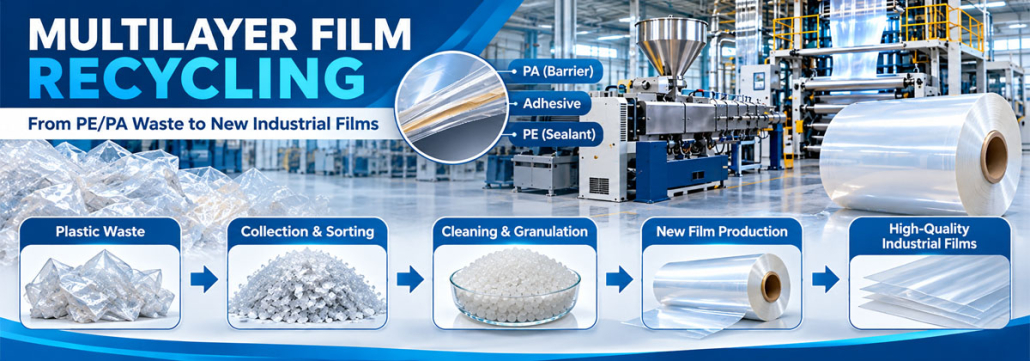
What happens to multilayer plastic film waste after it leaves a packaging production line? For manufacturers working with polyethylene (PE), polyamide (PA), lamination adhesives, and other functional materials, this question has become increasingly important.
Multilayer films are designed to combine properties that a single polymer may not provide efficiently. In vacuum packaging, for example, polyethylene can provide flexibility and heat-sealing performance, while polyamide contributes mechanical strength, puncture resistance, and gas-barrier functionality.
These characteristics make PE/PA structures valuable for applications that require reliable protection and controlled packaging performance. However, the same combination of materials creates difficulties when production scrap or used packaging needs to be recycled.
Unlike relatively homogeneous polyethylene waste, multilayer structures contain polymers with different chemical characteristics, melting behaviors, and rheological properties. Adhesives, printing inks, and other additives may introduce further complications.
For many years, these differences limited the possibility of converting multilayer packaging waste into recycled materials suitable for demanding applications.
Industrial developments, however, demonstrate that these challenges are not always insurmountable.
Companies such as BASF, IMCD, Windmöller & Hölscher (W&H), and Reifenhäuser have approached multilayer film recycling from different directions. Their work includes polymer compatibilization, structural recyclability assessment, industrial blown-film processing, and extrusion technologies capable of handling complex recycled materials.
Together, these experiences provide valuable insights into how multilayer packaging waste may be converted into usable raw materials.
The key lesson is straightforward: successful recycling depends not simply on melting the waste, but on understanding its composition, processing behavior, and intended end use.
Why Is PE/PA Multilayer Film Recycling Technically Challenging?
Polyethylene and polyamide have fundamentally different molecular structures.
Polyethylene is a predominantly nonpolar polymer with hydrocarbon chains. Polyamide, in contrast, contains polar amide groups capable of forming hydrogen bonds.
Because of these chemical differences, the two polymers have limited mutual compatibility under ordinary melt-processing conditions.
When PE/PA multilayer waste is heated and mixed in an extruder, the materials do not necessarily form a uniform polymer blend. Instead, separate polymer phases may develop, often with relatively weak interfacial adhesion.
This can lead to stress concentration, interfacial debonding, and deterioration of mechanical performance.
The morphology of the recycled blend is particularly important. Large or poorly distributed polyamide domains within a polyethylene matrix may create local defects, affecting film uniformity, tensile properties, and resistance to mechanical failure.
Adhesive-laminated structures introduce additional variables.
Such films may contain polyurethane-based adhesives, printing inks, processing additives, and other components that influence the behavior of the recycled melt.
Depending on their chemistry and thermal history, these materials can affect color stability, odor, melt flow, and extrusion performance.
Consequently, multilayer laminate waste cannot automatically be processed under the same conditions used for conventional polyethylene recycling.
Learn more » Stretch Hood Packaging
The Role of Maleic Anhydride-Grafted Polyethylene
One established approach to improving PE/PA compatibility involves maleic anhydride-grafted polyethylene, commonly referred to as PE-g-MAH.
This material contains polyethylene chains that are compatible with the PE-rich phase and reactive maleic anhydride groups that can interact chemically with suitable functional groups in polyamide.
In particular, maleic anhydride groups can react with terminal amine groups in PA under appropriate melt-processing conditions.
These interactions can improve interfacial adhesion, promote finer phase dispersion, and support more consistent mechanical performance.
However, compatibilization is not a universal solution.
Its effectiveness depends on several factors, including polymer composition, PA grade, functional-group concentration, compatibilizer dosage, melt temperature, residence time, and mixing intensity.
Excessive or insufficient compatibilizer may also affect properties differently.
This explains why industrial recycling projects require formulation development rather than a fixed additive recipe that can be applied to every multilayer film.
IMCD: Returning PE/PA Production Scrap to Transparent Film Manufacturing
A documented industrial example of multilayer film recycling was published by IMCD under the case study Making Multi-layer Transparent Packaging Sustainable.
The project involved a customer manufacturing multilayer plastic films for food packaging.
During production, the company generated scrap from different multilayer structures containing polyethylene and polyamide. Reusing these materials was technically difficult because conventional processing approaches could reduce the transparency and thermoforming performance of the resulting films.
The objective was therefore more demanding than simply converting production scrap into pellets.
The manufacturer needed recycled material that could return to the production process while preserving the properties required for transparent packaging.
How IMCD Addressed the Problem
According to IMCD, the customer had previously evaluated different processing approaches and conventional compatibilizers without achieving satisfactory results.
IMCD supplied a compatibilizer intended to improve the recycling of film structures containing polyamide or ethylene vinyl alcohol (EVOH).
With the selected material, recycled content could be incorporated into a transparent PE- or PP-based layer within a new multilayer structure.
The company reported a significant improvement in scrap reuse.
Between 2018 and 2021, the manufacturer had increased the reuse of production offcuts to approximately 80%. Following implementation of the new solution, the reported reuse level reached approximately 95% by the end of the first quarter of 2021.
An important distinction is necessary here.
The 95% figure refers to the proportion of production waste successfully reused. It does not mean that the final packaging film contained 95% recycled material.
IMCD also did not publicly disclose the complete formulation, precise compatibilizer chemistry, or comprehensive performance data for every film structure involved.
The reported outcome should therefore be understood as a successful application-specific case rather than a universal performance benchmark.
What Can Manufacturers Learn from IMCD?
The IMCD project highlights the importance of defining the final product requirements before designing a recycling process.
For transparent thermoforming films, producing pellets is only the first stage.
The recycled formulation must also demonstrate acceptable optical properties, thermoformability, mechanical performance, and processing stability.
A material that can be extruded successfully may still be unsuitable for a packaging application if its haze, surface quality, or forming behavior falls outside the customer’s specifications.
The project also illustrates the value of cooperation between film manufacturers, additive suppliers, and processing specialists.
Industrial reference: IMCD, Making Multi-layer Transparent Packaging Sustainable.
Learn more » Fresh Bag
BASF: Reassessing the Recyclability of Polyamide-Containing Multilayer Films
BASF has investigated multilayer film recycling from a different perspective.
Rather than focusing solely on recycled pellet production, the company has examined whether specific polyamide-containing packaging structures can be considered compatible with existing recycling systems.
Working with the independent Institute cyclos-HTP, BASF investigated several types of multilayer packaging.
This work is particularly relevant because polyamide has historically been treated as a problematic component in some polyethylene recycling guidelines.
BASF’s findings demonstrate that recyclability requires a more differentiated evaluation.
Three Categories of Multilayer Packaging
The investigations included three major structure groups:
- Coextruded polyethylene/polyamide multilayer films.
- Coextruded polyethylene/polyamide/EVOH high-barrier films.
- Adhesive-laminated polyethylene/polyamide films.
For coextruded PE/PA structures, BASF reports conditional recycling compatibility for certain films containing up to 30% PA6 or PA6/6.6 copolyamide when suitable PE-g-MAH compatibilization is used.
The company has also reported conditional recycling compatibility for specified structures containing up to 30% PA6 and 5% EVOH.
This finding challenges the assumption that any EVOH-containing multilayer structure must automatically be classified as non-recyclable.
However, it does not establish that all EVOH-containing films are compatible with every recycling system.
The polymer grades, concentrations, layer structures, and intended recycling pathways remain essential.
What About Adhesive-Laminated PE/PA Films?
One of BASF’s particularly relevant findings concerns BOPA/PE adhesive-laminated structures.
BOPA refers to biaxially oriented polyamide film, which is commonly laminated with polyethylene in flexible packaging applications.
BASF reports that specified adhesive-laminated BOPA/PE structures containing PE-g-MAH, with a combined polyamide and adhesive content of up to approximately 23%, received conditional recycling-compatibility certification.
This is important for manufacturers using adhesive lamination rather than coextrusion.
It demonstrates that the presence of lamination adhesive does not automatically eliminate the possibility of mechanical recycling.
Nevertheless, the certification applies to the evaluated structures and conditions.
It cannot be extended indiscriminately to all polyurethane adhesives, all polyamide grades, or all PE/PA blend compositions.
What Does a 100% Recyclability Rating Mean?
BASF reports that cyclos-HTP assigned a 100% recyclability rating to certain PE/PA6 structures compatibilized using a ratio of 0.15 g of compatibilizer per gram of PA6.
This result must be interpreted in the context of the relevant certification methodology and recycling pathway.
A recyclability rating is not the same as a real-world collection rate, recycling-plant yield, or guarantee that all packaging will be successfully recovered.
Material losses, sorting conditions, contamination, and the availability of suitable recycling infrastructure may still affect the actual amount of recovered material.
These distinctions are essential when evaluating environmental claims or communicating recyclability to industrial customers.
The Broader Lesson from BASF
BASF’s work suggests that decisions about retaining or eliminating polyamide should consider both packaging performance and end-of-life management.
In some applications, PA provides valuable mechanical or barrier properties.
Removing it may require the development of another multilayer structure or potentially greater material thickness to meet equivalent functional requirements.
Therefore, designing recyclable packaging should not be reduced to eliminating individual polymers without evaluating the consequences for product performance.
Technical reference: BASF, Mechanical Recycling of Polyamide-containing Multilayer Structures.
Learn more » Vacuum Channel Bags
Windmöller & Hölscher: Producing Recycled PE/PA Film on Industrial Equipment
While BASF’s work focuses on material structures and recyclability assessments, Windmöller & Hölscher has demonstrated the processing of recycled PE/PA materials using industrial blown-film equipment.
During its in-house exhibition held alongside K 2022, W&H presented three-layer blown films containing recycled PE/PA and PE/copolyamide/EVOH materials.
This demonstration is significant because a successful laboratory extrusion trial does not automatically demonstrate reliable industrial film production.
Blown-film processing requires controlled melt behavior and consistent bubble stability.
The production line must also maintain film thickness, surface quality, mechanical properties, and acceptable levels of visible defects.
Materials containing poorly dispersed polymer phases or thermally degraded components may interfere with these requirements.
Industrial Processing Conditions
W&H produced three-layer films with a total thickness of 50 micrometers using an air-cooled VAREX II blown-film line.
The company reported a blow-up ratio of approximately 1:2.7 and a production throughput of 400 kg/h.
The middle layers of the experimental films contained approximately 25–32 wt.% recycled material.
An important distinction is that this percentage refers to the middle layer, not necessarily the entire film.
For the PE/PA6-based example, the overall recycled content was approximately 21% of the total film mass.
Confusing the recycled content of a particular layer with that of the complete structure can produce misleading comparisons between recycling technologies.
How Did the Recycled Films Perform?
According to W&H, the recycled-content films showed mechanical and optical performance comparable to the polyethylene reference in several evaluated properties.
The reported measurements included tensile characteristics, tear resistance, puncture behavior, and haze.
Some results showed improved Elmendorf tear resistance relative to the reference film.
However, mechanical performance must always be assessed property by property.
An improvement in tear resistance does not necessarily imply higher tensile strength, better puncture resistance, or greater elongation at break.
Likewise, comparable laboratory results do not guarantee identical performance under every packaging condition.
Why Is the Middle Layer Useful?
The use of recycled material in the middle layer of a multilayer film offers a potentially valuable design strategy.
The external layers can be selected to provide particular surface, sealing, or optical properties, while recycled material is incorporated into an internal layer.
This may allow manufacturers to use a higher proportion of recycled material without exposing it directly at the film surface.
Nevertheless, the internal layer remains mechanically important.
If poorly dispersed polymer domains, gels, or contaminants create weak regions, the external layers cannot necessarily compensate for them.
The design must therefore be validated as a complete film structure.
Industrial Demonstration Versus Continuous Commercial Production
Producing film at 400 kg/h demonstrates processing feasibility on industrial-scale machinery.
It does not, by itself, establish that the same formulation has been continuously manufactured and commercially sold under all operating conditions.
Commercial qualification additionally requires stable product quality, manageable scrap rates, consistent feedstock, and customer approval.
Technical reference: Windmöller & Hölscher, Polyethylene (PE) / Polyamide (PA) Multilayer Films Are Mechanically Recyclable! (2022).
Learn more » Thermoforming Film
Reifenhäuser: Processing Complex Industrial Film Waste into New Products
Reifenhäuser has approached multilayer recycling through extrusion-equipment development.
Its EVO Fusion technology is designed to improve the processing of post-industrial waste, including material streams that are difficult to recycle using conventional approaches.
Such waste may contain multilayer films, printed materials, adhesive-laminated structures, and combinations of different polymer classes.
These materials create challenges because their properties and compositions may vary substantially.
How EVO Fusion Works
The EVO Fusion system uses twin-screw extrusion technology to process recycled material, including film shreds or fluff.
The approach emphasizes melt homogenization and degassing to support the processing of heterogeneous material streams.
In suitable configurations, shredded film waste can be introduced into the extrusion process without a separate intermediate regranulation step.
Avoiding an additional pelletizing cycle may reduce thermal exposure and energy consumption.
However, processing results still depend on the feedstock composition, contaminant levels, equipment configuration, and target product.
Reifenhäuser has published several application examples demonstrating different recycled-content levels.
Application 1: Trash-Bag Film from Adhesive-Coated Waste
The company reports that production waste from adhesive-coated film can be processed into film containing 100% recycled material.
The resulting film is suitable for applications such as trash bags.
This example demonstrates that adhesive-containing production waste may be processed into useful film rather than automatically being discarded.
However, the adhesive chemistry and processing conditions remain important. The example should not be interpreted as proof that every adhesive-laminated PE/PA waste stream will produce equivalent results.
Application 2: Construction Film with 70% Recycled Content
Reifenhäuser also reports the production of construction film containing approximately 70% recycled material from multilayer barrier-film waste.
This represents an alternative approach to material recovery.
Instead of requiring the recycled polymer to return to the original high-barrier packaging application, the material is used in a product category with a different set of requirements.
Construction films may have less demanding transparency requirements than certain consumer packaging products.
Nevertheless, their mechanical durability, puncture resistance, aging behavior, and relevant barrier performance must still meet the requirements of the intended application.
Application 3: Laminating Film for Stand-Up Pouches
Another reported example involves duplex laminate waste containing different materials, such as PET and PE, along with potential printing inks and adhesives.
Using EVO Fusion technology, Reifenhäuser reports producing laminating film for stand-up pouches with recycled content of up to 60%.
The company also reports processing triplex laminate waste into film containing 52% recycled material.
These cases illustrate that industrial recycling opportunities are not limited to relatively simple, single-polymer waste streams.
At the same time, success with PET/PE laminate waste should not be treated as identical evidence for PE/PA recycling.
Potential Energy Benefits
Reifenhäuser states that direct processing of film shreds can provide energy savings of up to 40% by eliminating an intermediate regranulation step.
This is a technology-specific claim rather than a universal energy-saving figure for every recycling operation.
Actual performance will depend on the baseline process, material characteristics, plant configuration, and operating conditions.
Industrial reference: Reifenhäuser, Opening Up New Applications with Post-industrial Recyclate (2024).
Comparing the Four Industrial Approaches
These four companies demonstrate that multilayer-film recycling involves several interconnected technical challenges.
| Company | Primary approach | Reported outcome | Important limitation |
| IMCD | Compatibilizer selection and formulation optimization | Approximately 95% production-scrap reuse | Full formulation not publicly disclosed |
| BASF | Structural recyclability assessment | Conditional certification of selected PE/PA and adhesive-laminated structures | Results apply to specified structures and recycling pathways |
| Windmöller & Hölscher | Industrial blown-film processing | 50 µm three-layer films containing PE/PA recyclate | Industrial demonstration does not prove continuous commercial production |
| Reifenhäuser | Advanced extrusion of complex recyclates | Films produced with varying recycled-content levels | Feedstock quality and application requirements remain critical |
The comparison highlights an essential principle: recycled multilayer waste does not always need to return to its original packaging application.
In some cases, direct reuse in the same product may be technically difficult or economically unattractive.
Alternative applications, including industrial protective films, construction films, or other non-food products, may provide more practical recycling pathways.
Identifying a suitable application can therefore be just as important as improving the recycling process itself.
Technical Limitations That Still Matter
Despite the progress demonstrated by international manufacturers, several practical limitations remain.
Thermal Degradation and Discoloration
Recycled materials have typically experienced at least one previous processing cycle.
Additional exposure to heat, oxygen, and prolonged residence times can change the chemical structure of certain components.
In PE/PA films containing lamination adhesives, these changes may contribute to discoloration, odor generation, or changes in rheological behavior.
However, discoloration alone does not establish a particular degradation mechanism.
Its origin may involve polymer oxidation, adhesive components, additives, contaminants, or combinations of these factors.
Moisture Management
Polyamide is more hygroscopic than polyethylene.
Residual moisture can influence extrusion performance and, under unsuitable conditions, promote hydrolytic degradation of polyamide chains.
Controlled drying and moisture monitoring may therefore be important when processing recycled PE/PA blends.
Melt Flow Index Is Not Sufficient
Melt flow index (MFI) provides useful information about material flow under standardized test conditions.
However, MFI alone cannot establish suitability for blown-film production.
Materials with similar MFI values may exhibit different melt strength, extensional behavior, bubble stability, and defect formation.
Practical material qualification should therefore include appropriate rheological evaluation and film-production trials.
Adhesive Residues and Extractable Compounds
Adhesives and other residual components may affect odor, discoloration, and the presence of extractable substances.
This is particularly relevant when evaluating recycled materials for sensitive packaging applications.
Mechanical recyclability and food-contact compliance are separate considerations.
A material that can be successfully recycled is not automatically approved for direct food-contact use.
Recycling Regulations: Why the Definition of Recyclability Matters
Packaging recyclability is increasingly being evaluated according to real sorting and recovery conditions rather than theoretical material properties alone.
In Germany, the Central Agency Packaging Register (ZSVR), in agreement with the German Environment Agency (UBA), publishes a minimum standard for determining packaging recyclability.
The 2026 edition was published on August 31, 2026.
The standard considers the practical ability of packaging components to enter suitable sorting and recycling processes and be recovered for further use.
This distinction matters because a material may be technically melt-processable but difficult to identify, separate, or recover within existing recycling infrastructure.
The European Union has also introduced Regulation (EU) 2025/40, known as the Packaging and Packaging Waste Regulation (PPWR).
The new rules began applying on August 12, 2026, with additional requirements scheduled for future years.
Among the regulation’s objectives is improving packaging recyclability and increasing recycled-content use, with major milestones beginning in 2030.
For packaging manufacturers, these developments reinforce the importance of considering end-of-life management during material selection and product design.
What Do These Experiences Mean for Karya Polymer and Industrial Packaging Manufacturers?
For packaging manufacturers in Iran and other industrial markets, the most valuable lesson is not that every multilayer film can be recycled without restriction.
It is that recycling opportunities should be assessed according to the actual waste composition and the performance requirements of the intended application.
For companies such as Karya Polymer, this approach offers a useful framework for evaluating production scrap and exploring future recycled-material applications.
Consider an adhesive-laminated film containing polyethylene, polyamide, and polyurethane-based adhesive.
Before selecting an end use for its recycled granules, manufacturers should establish the relative proportions of the main components, identify relevant additives, and evaluate material stability.
They must then determine whether the recycled blend is suitable for film production or requires formulation adjustments.
Potential Product Development Routes
Non-food industrial films: These offer an opportunity to evaluate extrusion stability, mechanical performance, and recycled-material consistency without automatically assuming suitability for food-contact applications.
Middle layers of multilayer films: W&H’s work demonstrates that controlled incorporation of recycled material into an internal film layer can be a technically relevant approach.
Construction and protective films: Depending on the required properties, these products may tolerate different appearance characteristics than transparent consumer packaging. Their mechanical and durability requirements must nevertheless be met.
Compounds for industrial molded products: Recycled PE/PA blends may also be investigated for selected molded applications when melt-flow behavior and mechanical properties are suitable.
These are potential development pathways, not established commercial uses for every recycled PE/PA formulation.
How Should a Recycling Project Be Evaluated?
An effective technical assessment should begin with material identification and proceed toward application-specific qualification.
FTIR analysis can help identify chemical functional groups.
Differential scanning calorimetry (DSC) can provide information about melting behavior and crystallinity.
MFI testing and rheological analysis can support melt-processing assessment.
Mechanical testing should be selected according to the intended product. Tensile strength, elongation at break, tear resistance, and puncture resistance describe different aspects of film behavior and should not be treated as interchangeable.
Where barrier properties are relevant, oxygen transmission rate and water vapor transmission rate should be measured under appropriate conditions.
The commercial assessment should also address feedstock consistency, production yield, processing cost, and customer specifications.
Separating production waste according to material composition and processing history can make downstream quality control more manageable.
These considerations help manufacturers move beyond the question of whether waste can be melted and toward the more useful question of whether it can become a consistent, commercially viable material.
Conclusion
The experiences of BASF, IMCD, Windmöller & Hölscher, and Reifenhäuser demonstrate that multilayer film recycling has progressed beyond laboratory investigation.
Documented developments now include improved compatibilization, reuse of manufacturing scrap, certification of selected multilayer structures, and film production using recycled material on industrial-scale equipment.
Nevertheless, these successes do not establish a universal recycling method for all PE/PA films.
Material composition, adhesive chemistry, processing conditions, product specifications, and recycling infrastructure remain decisive factors.
The most effective approach combines polymer engineering, process control, and careful selection of the final application.
For industrial packaging manufacturers, this creates opportunities to consider production waste not merely as a disposal problem, but as a potential feedstock for new products following appropriate technical and economic evaluation.
For Karya Polymer, the international examples offer a foundation for informed discussions about recyclable film design, material selection, production-waste management, and potential recycled-material applications.
The future of multilayer packaging recycling is not simply about using more recycled material. It is about recovering material in a way that preserves the performance, consistency, and reliability required by the next product.


Leave a Reply
Want to join the discussion?Feel free to contribute!