


Recycling of multilayer laminated film and production of granules؛ Karya Polymer
Recycling multilayer laminated films remains one of the technical challenges facing the flexible packaging industry. These films combine different polymeric materials to deliver specific functional properties, but their complex composition makes recycling and reuse more difficult than processing conventional single-polymer waste.
Multilayer packaging films may contain several polymers, bonding layers, and functional additives. Together, these components provide properties such as mechanical strength, flexibility, heat sealability, and barrier performance.
However, differences in the chemical structures and thermal behavior of these materials can complicate recycling and affect the quality of the recovered polymer.
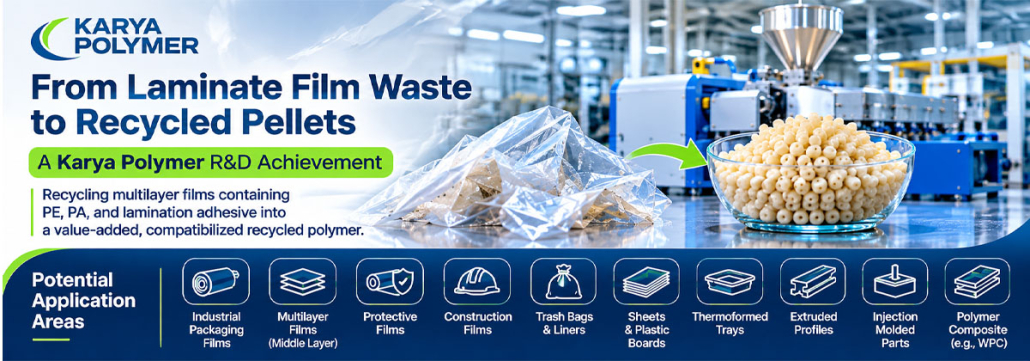
As part of its research and development activities, Karya Polymer has successfully converted multilayer laminated film waste into recycled polymer pellets.
This achievement reflects the company’s efforts to address the technical challenges associated with recycling complex polymer structures while exploring opportunities to recover value from manufacturing waste.
The project represents an important step toward developing secondary polymer materials and identifying potential applications beyond conventional waste management.
Karya Polymer’s R&D Achievement
One of the main difficulties in recycling multilayer films is the difference between the physical and chemical characteristics of their constituent materials.
These differences may influence material uniformity, melt-flow behavior, mechanical properties, and the overall quality of the recycled product.
Through its research and development efforts, Karya Polymer has produced recycled polymer pellets from multilayer laminated film waste, demonstrating the potential to recover materials from complex packaging structures.
The project focused on addressing polymer compatibility challenges and exploring the possibility of reusing the recovered material in future manufacturing applications.
The resulting material belongs to the category of recycled polymer blends, offering opportunities for further evaluation across different polymer processing technologies.
Rather than viewing laminated film waste solely as a material for disposal or low-value recovery, this initiative explores its potential as a secondary raw material.
Understanding Recycled Material Properties and Their Importance
Producing recycled polymer pellets is an important achievement, but their potential industrial value also depends on understanding their material characteristics and suitability for subsequent processing.
For recycled polymer blends, factors such as melt behavior, physical consistency, appearance, and processing stability influence the selection of suitable end products.
Melt-flow behavior is particularly relevant because it can affect polymer processing operations, product formation, and final product quality.
Another important consideration is the appearance and color stability of recycled materials.
Changes in color may be associated with the characteristics of the original material, its processing history, or environmental conditions during storage.
The significance of these changes depends on the intended application. Transparent packaging products, for example, may require strict control of optical appearance, whereas certain opaque industrial products may place greater emphasis on mechanical and functional performance.
For this reason, recycled materials should be evaluated according to the requirements of their intended applications rather than a single general quality criterion.
Karya Polymer’s R&D approach has focused on understanding the potential of recycled polymer materials and identifying possible pathways for future industrial product development.
Learn more » Low Melt Batch Inclusion Bag
Potential Industrial Applications of Recycled Laminated Film Materials
One of the most promising aspects of multilayer film recycling is the possibility of developing products with different functional requirements from those of the original packaging.
Industrial research and published manufacturing examples indicate that recycled polymer blends can be considered for a range of applications, depending on material properties, processing requirements, and final product specifications.
Based on the nature of the recycled material developed within Karya Polymer’s R&D project, several potential application areas can be identified.
- Non-Food Industrial Packaging Films
Industrial packaging films are one potential application for recycled polymer materials.
These films are widely used for wrapping, protecting, and transporting industrial products.
Depending on the intended use, they may require appropriate flexibility, mechanical strength, and resistance to tearing.
Recycled polymer materials can be evaluated for such applications when their processing behavior and performance meet the required specifications.
- Middle Layers of Multilayer Films
Incorporating recycled materials into the middle layer of multilayer films is an approach that has been investigated within the packaging industry.
This strategy allows different layers of a film structure to perform specific functions while recycled material is incorporated into a selected internal layer.
The suitability of this approach depends on overall film performance and compatibility between the layers.
- Industrial Protective Films
Industrial protective films are used to protect equipment, components, and manufactured products during production, handling, storage, and transportation.
These applications may require flexibility, durability, and resistance to mechanical damage.
Recycled materials could be considered for selected protective film products where they satisfy the relevant functional requirements.
- Construction Films
Construction films represent another potential application for recycled polymer materials.
These products may be used for temporary covering, protection of construction materials, and other general construction-related purposes.
For some applications, transparency may be less important than mechanical durability and resistance to damage.
However, the performance requirements must be evaluated according to the specific intended use.
- Trash Bag Films and Industrial Liners
Trash bag films and industrial liners are among the product categories in which recycled polymer materials may be considered.
Depending on their application, these products require suitable flexibility, tear resistance, and sealing performance.
The use of recycled materials must therefore be supported by appropriate product development and performance evaluation.
- Polymer Sheets and Plastic Boards
Polymer sheets and plastic boards are used across various industries for protective panels, separators, and formed products.
The development of recycled polymer sheets offers another potential route for converting recovered materials into industrial products.
Material selection and processing conditions must be compatible with the required sheet thickness, dimensional stability, and mechanical properties.
- Thermoformed Trays and Industrial Components
Thermoformed trays and industrial components can be manufactured from suitable polymer sheets.
These products are used in component packaging, equipment organization, storage systems, and non-food industrial applications.
Recycled polymer materials may be investigated for such products when they demonstrate adequate sheet-forming characteristics and final-part performance.
- Industrial Extruded Profiles
Extruded polymer profiles are another possible application for recycled polymer blends.
These products may include protective strips, separators, and selected non-load-bearing industrial components.
Their feasibility depends on material flow characteristics, dimensional stability, and mechanical requirements.
- Injection-Molded Plastic Components
Injection-molded plastic components, including selected housings, covers, and non-critical industrial parts, represent another potential development pathway.
Successful use in injection molding depends on melt-flow behavior, dimensional consistency, and mechanical performance.
The suitability of recycled polymer blends must therefore be assessed according to individual product requirements.
- Reinforced Polymer Composites
Reinforced polymer composites are an important area of development for recycled polymer materials.
Combining suitable recycled polymers with reinforcing materials may create opportunities to develop products with different stiffness, strength, or other functional characteristics.
This approach offers a potential route toward higher-value recycled polymer applications.
- Wood–Plastic Composites (WPC)
Wood–plastic composites (WPC) are used in products such as profiles, landscaping components, and certain non-structural building applications.
Investigating the compatibility of recycled polymer blends with wood-based or other suitable fillers represents a possible direction for further product development.
- Polymer Products for Logistics and Material Handling
Industrial trays, transport separators, protective covers, and selected plastic components used in logistics and warehousing are additional potential applications.
These products may require impact resistance, dimensional stability, and suitable mechanical performance, depending on their operating conditions.
The applications described above represent potential product development opportunities. They should not be interpreted as confirmation that Karya Polymer has commercially manufactured or qualified its recycled material for every listed application.
The Importance of Multilayer Film Recycling for the Packaging Industry
Recovering usable polymer materials from laminated film waste can contribute to broader industrial efforts to improve resource efficiency.
This is particularly relevant for multilayer packaging, where the combination of different materials can make conventional recycling more difficult.
Developing suitable recycling approaches may create opportunities to reduce material losses, recover manufacturing waste, and explore new sources of secondary polymer raw materials.
However, the value of recycled material is determined not only by its recovery, but also by its ability to meet the performance requirements of a useful end product.
This requires consideration of material characteristics, processing suitability, quality consistency, and application-specific performance.
Karya Polymer’s R&D initiative reflects this approach by exploring the potential of multilayer laminated film waste as a resource for future material development.
Learn more » Thermoforming Film
Conclusion: Advancing Polymer Recycling Through Research and Development
Through its research and development activities, Karya Polymer has successfully produced recycled polymer pellets from multilayer laminated film waste.
This achievement provides a foundation for exploring new applications for recovered polymer materials and reflects the company’s commitment to investigating technical solutions for resource recovery.
Industrial films, protective packaging, polymer sheets, extruded profiles, molded components, and reinforced polymer composites are among the potential areas for further product development.
By focusing on polymer technology, material understanding, and the evolving needs of the packaging industry, Karya Polymer continues to explore opportunities to create value from polymer waste.
From manufacturing waste to reusable raw materials: advancing polymer technology and resource efficiency through research and development.

Leave a Reply
Want to join the discussion?Feel free to contribute!