


MAP vs. VSP Meat Packaging: Which Is Better?
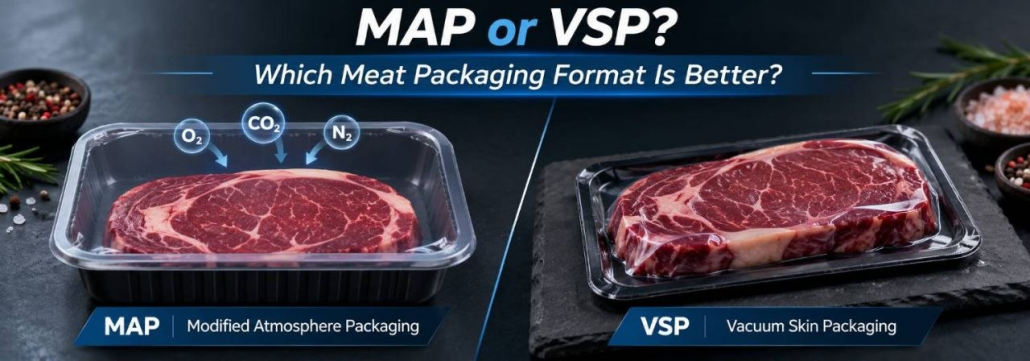
In fresh meat packaging, appearance is often the first feature consumers notice. A bright red color, a clear pack, and minimal visible liquid can all influence how shoppers perceive freshness. For a meat processor, however, packaging quality involves much more than shelf appeal.
Product shelf life, color stability, lipid oxidation, microbial growth, film resistance, seal integrity, and total packaging cost all contribute to the selection of a suitable system. Modified Atmosphere Packaging (MAP) and Vacuum Skin Packaging (VSP) are two established options for fresh meat, but they work in fundamentally different ways.
MAP controls the atmosphere surrounding the meat. VSP removes air and applies a highly conformable film closely over the product surface. Understanding this distinction is essential before deciding which system better meets a product’s technical and commercial requirements.
What Is Modified Atmosphere Packaging (MAP)?
Modified Atmosphere Packaging replaces the air surrounding a food product with a selected mixture of gases. In a typical meat application, the product is placed in a tray, the internal atmosphere is adjusted, and a barrier lidding film is heat-sealed to the tray.
The most common gases and their functions are oxygen (O₂), which helps maintain the bright red appearance of fresh red meat in high-oxygen MAP; carbon dioxide (CO₂), which inhibits the growth of certain spoilage microorganisms; and nitrogen (N₂), a relatively inert gas used to balance the atmosphere and maintain headspace volume.
The proportions are not universal. Meat type, fat content, storage conditions, desired appearance, and other product characteristics influence the formulation. In some fresh red meat applications, mixtures of approximately 70–80% oxygen and 20–30% carbon dioxide have been studied and used, but these are examples rather than prescriptions for every processing line.
Why Does Oxygen Matter in MAP?
The color of meat is strongly influenced by myoglobin, a pigment that exists in different chemical forms. When oxygen binds to myoglobin, oxymyoglobin forms and produces the bright red appearance many shoppers associate with fresh beef.
Oxygen, however, can also accelerate the oxidation of meat pigments and lipids. High-oxygen MAP therefore presents a practical trade-off: it can improve initial red color display while potentially promoting oxidative changes during storage. Experimental comparisons, including work by Łopacka and colleagues (2016), have reported higher lipid oxidation under certain high-oxygen MAP conditions than under VSP.
What Is Vacuum Skin Packaging (VSP)?
With Vacuum Skin Packaging, meat is positioned on a suitable tray or base board. Air is evacuated from the packaging chamber, and a purpose-designed top film is formed over the three-dimensional product surface under controlled temperature and pressure. The film closely follows the meat’s contours and is sealed to the supporting substrate.
Unlike conventional MAP, VSP does not rely on a substantial gas-filled headspace. Instead, its design minimizes free space and limits the amount of oxygen available around the product.
Reduced Contact with Oxygen
By limiting oxygen exposure, VSP can slow certain oxidative reactions, including changes in lipids and meat pigments. Actual protection depends on residual oxygen, oxygen transmission through the film, sealing quality, and storage conditions.
Minimal Headspace
Because the film conforms closely to the product, there is little free space around the meat. This can hold the portion in position and create a neat retail presentation.
Clear Presentation of the Product Shape
A suitable skin film follows the natural geometry of steaks and fillets, allowing consumers to see their shape and surface. This can be especially valuable for premium cuts where visual presentation contributes to perceived value. It requires appropriate film selection and correct machine settings.
Why Polymer Film Engineering Matters in VSP
The films used for MAP and VSP face different processing demands. A MAP lidding film must provide a reliable seal and help preserve the specified atmosphere. Depending on the application, oxygen and moisture barrier properties may also be critical.
A VSP film must meet those protective requirements while also stretching or forming smoothly over a three-dimensional product. That makes material selection an engineering decision, rather than merely the purchase of a clear plastic cover.
Why Are Multilayer Films Common?
A single polymer may not provide the complete combination of properties required for demanding food packaging. Multilayer designs can integrate different functions: polyethylene (PE), for example, may contribute sealability and flexibility; ethylene vinyl alcohol (EVOH) may provide an oxygen barrier; and tie layers may support adhesion between otherwise incompatible polymers. The actual structure varies by product and application.
Key characteristics to evaluate include formability and resistance to excessive local thinning, puncture resistance around sharp product features and bones, oxygen transmission rate (OTR), seal integrity and compatibility with the tray or base, and clarity and gloss for product display.
Film thickness alone is not a sufficient measure of suitability. Layer structure, raw material properties, forming behavior, packaging geometry, and machine settings together determine how the film performs on the line.
Which System Provides Longer Meat Shelf Life?
It is tempting to assume that VSP always extends shelf life beyond MAP because it reduces oxygen exposure. The available evidence does not support such a universal claim. Shelf life also depends on initial microbial load, meat type, storage temperature, gas formulation, film barrier performance, and sealing quality.
Comparative studies of beef and pork have shown that package performance changes with the experimental conditions and the quality measure being assessed. Some high-oxygen MAP conditions are associated with earlier oxidative changes than VSP. Other studies, particularly with different products and atmospheres, have found advantages for MAP in selected shelf-life measures.
For processors, the most defensible approach is to validate shelf life using their own product, packaging components, distribution temperature profile, and microbiological and sensory criteria. The packaging format alone cannot establish a reliable use-by date.
MAP vs. VSP: What Happens to Meat Color?
Color is one of the clearest differences. High-oxygen MAP encourages oxymyoglobin formation and often presents beef with a bright red surface. In low-oxygen vacuum skin packs, meat may appear darker red or purplish because deoxymyoglobin is more prevalent.
A darker color inside a VSP pack is not, by itself, evidence of spoilage. After the package is opened and the meat is exposed to air, the surface may develop a brighter red color through a process commonly called blooming. Whether and how fully this occurs depends on pigment condition, storage history, and other factors.
In comparative studies, MAP has sometimes produced a brighter retail color while showing greater lipid and pigment oxidation than VSP. Brighter red meat, therefore, is not necessarily more chemically stable meat.
How Do MAP and VSP Affect Purge and Shelf Presentation?
Purge is the liquid released from meat during storage. Its quantity depends on muscle structure, water-holding capacity, storage time, and packaging conditions. In a tray with headspace, purge can collect visibly at the bottom, sometimes prompting the use of absorbent pads.
With VSP, the close-fitting film may reduce visible pooling and maintain a more organized display. But it is important to distinguish between reducing visible liquid accumulation and actually preventing water loss from the meat. Studies comparing skin packs with conventional vacuum packaging have identified differences in purge under particular conditions, but findings cannot be generalized to every product.
MAP vs. VSP: Technical Comparison
| Criteria | MAP | VSP |
| Packaging principle | Controlled gas mixture around the product | Air evacuation and conformable film in close contact with product |
| Meat color | Bright red appearance possible with high-oxygen MAP | Darker red or purplish color common in low-oxygen conditions |
| Oxidation | May be higher with high-oxygen MAP | Often lower with well-controlled low-oxygen packaging |
| Shelf life | Depends on gas mixture, product, temperature, and package performance | Depends on vacuum conditions, film, product, and temperature |
| Presentation | Product visible within a tray with headspace | Film closely follows the natural product shape |
| Critical film properties | Barrier performance and sealing | Barrier performance, formability, puncture resistance, and sealing |
| Material use | Depends on tray and lid design | Depends on skin film and supporting substrate |
| Cost factors | Gas, equipment, materials, and line efficiency | Specialized film, equipment, substrate, and line efficiency |
| Typical selection logic | Flexible option for multiple protein products | Strong option for distinctive presentation of individual cuts |
Is VSP More Sustainable or Material-Efficient?
Claims that one system always uses less plastic should be treated carefully. A MAP format may employ a relatively deep tray and lidding film; a VSP format may use a shallower tray or suitable base with a specially formable top film. The correct comparison is the mass and type of all packaging components, not only the thickness of one film.
Multilayer barrier structures can also complicate recycling, in both formats, depending on the design and the collection and recycling infrastructure available. Another environmental consideration is food waste: a pack that maintains product quality and prevents avoidable disposal can have benefits that must be weighed alongside its material footprint.
A meaningful environmental comparison therefore requires a life-cycle perspective covering packaging materials, product waste, transport, and end-of-life treatment. Without that analysis, neither format should be described as inherently more sustainable.
Is VSP Always More Expensive Than MAP?
Packaging costs go beyond the price per square meter of film. MAP includes gas supply and dosing, packaging machinery, trays, lidding films, quality control, and production efficiency. VSP requires suitable skin film, compatible equipment, a base or tray, and carefully controlled forming and sealing conditions.
A complete economic comparison should also account for packaging defects, product loss, returns, throughput, and the quantity of saleable product. A format with higher material cost can still be economically justified in a particular operation, but any claimed savings should be supported by actual production and distribution data.
An Essential Reminder: Packaging Does Not Replace the Cold Chain
Neither MAP nor VSP guarantees microbial safety on its own. Reducing oxygen may limit some aerobic spoilage organisms, but not all pathogens require oxygen to grow. Good manufacturing hygiene, control of initial contamination, proper refrigeration, a validated shelf life, and reliable seals remain essential.
Vacuum-packed meat is still perishable and must be stored under appropriate temperature conditions. This safety principle is reflected in guidance from the U.S. Department of Agriculture Food Safety and Inspection Service (USDA FSIS).
So, Which Packaging System Should Meat Producers Choose?
The answer depends on the product and the business objective. When a bright red retail appearance is the top priority, high-oxygen MAP may be attractive, provided the processor also considers its potential influence on oxidation and product quality.
When reducing oxygen contact, minimizing headspace, securing the meat within the pack, and presenting the product’s natural contours are central goals, VSP deserves careful consideration. It can be especially suitable for steaks, fillets, and other cuts where presentation is part of the product’s commercial value.
The final outcome depends on the complete packaging system. Even a film with strong barrier performance may disappoint if it lacks adequate formability or forms an unreliable seal. Product geometry, machine compatibility, processing conditions, and distribution requirements should all inform selection.
Vacuum Skin Packaging Films at Karya Polymer
In vacuum skin packaging, polymer film performance is a central part of pack quality. The film must conform to the product while retaining appropriate protective characteristics and sealing reliably under actual production conditions.
Karya Polymer includes vacuum skin packaging (VSP) films within its food-packaging portfolio for applications such as red meat, poultry, seafood, and other protein products. Its publicly available product information discusses characteristics including formability, oxygen barrier performance, puncture resistance, clarity, and leakage prevention.
To evaluate a film for a specific application, processors should consider their packaging equipment, product geometry, process settings, and storage conditions, and seek product-specific technical specifications where needed.
Karya Polymer VSP product page: https://karyapolymer.com/vacuum-skin-pack-vsp-film1/?lang=fa
Editorial Notes Before Publication
Do not claim that VSP always delivers longer shelf life than MAP; results vary by formulation, meat type, temperature, and the selected quality criterion. Also avoid assigning specific OTR values, seal strengths, puncture resistance figures, or shelf-life extensions to Karya Polymer films without validated product data or test reports.

Leave a Reply
Want to join the discussion?Feel free to contribute!